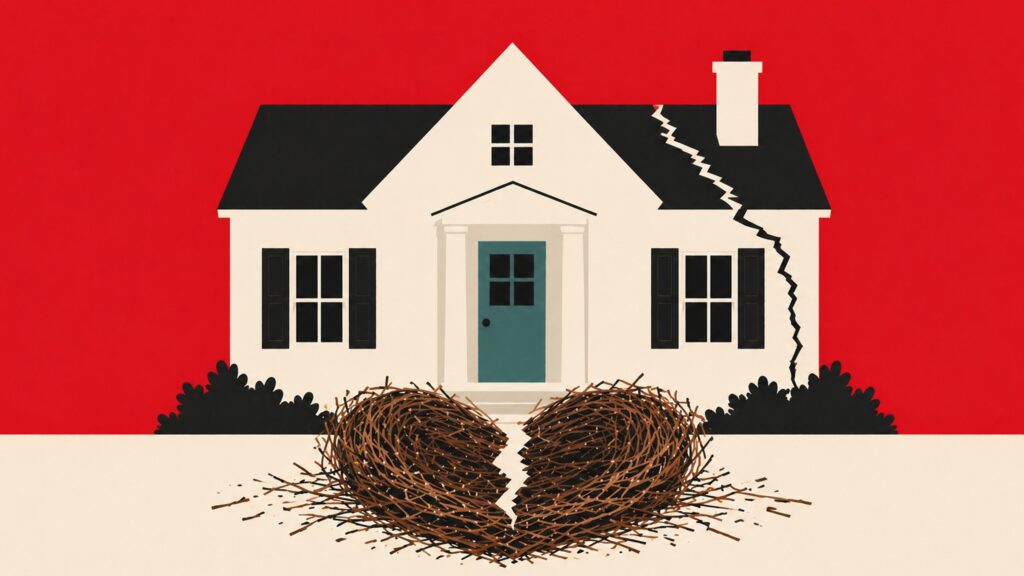
The proportion of American citizens who’re each married and personal a house by way of age 30 has shriveled from 52% in 1960 to only 12%, in step with new knowledge—in a stunning cave in that has the possible to affect the long run web price of those {couples}, in addition to the long-term well being of the housing marketplace and U.S. economic system.
The knowledge, in line with an research of U.S. Census Bureau data, highlights the twin affect of social shifts and a continual housing scarcity. The latest research from Realtor.com® pegs the nationwide housing deficit at 4.03 million properties, whilst different estimates from the White Space position the dearth as prime as 10 million.
And whilst the demise of the affection nest—the standard first homestead of newlyweds—may look like little greater than a metamorphosis in way of life alternatives, economists say it indicators a basic breakdown within the conventional trail to middle-class safety.
Who’s accountable for the demise of the affection nest?
It’s herbal to need to level palms when the information is so stark. However Hannah Jones, senior financial analysis analyst at Realtor.com, says it’s extra difficult than any unmarried issue.
As an alternative, Jones attributes the shift to 2 compounding forces: adults marrying later and dramatically worsening housing affordability.
An vast majority (75%) of 25- to 34-year-olds have been married in 1960; these days, that determine is solely 38%. This variation on my own has considerably decreased the quantity of people that are compatible the standard homebuyer profile—let on my own who can have the funds for to shop for a house these days.
To that 2nd level, house costs have skyrocketed for the reason that Sixties. Jones notes that within the Sixties, the standard house was once priced about two to a few instances the median revenue. Nowadays, that ratio has risen to more or less 5 instances nationally.
The associated fee-to-income ratio measures the connection between house prices and income, serving as a key indicator of accessibility into the housing marketplace. For standpoint, the median family revenue in 1960 was once $5,600, in step with the U.S. Census Bureau, whilst the median price of a house was once slightly below $12,000—a ratio of two.14.
Nowadays, the median family revenue is $84,000, however the median house payment has reached $425,000 at a ratio of five, as Jones notes. For the price-to-income ratio to go back to Sixties ranges with out house costs falling, the median family revenue would want to bounce to almost $200,000.
As that ratio has larger, homeownership has develop into structurally tougher for all families to succeed in. Jones provides that younger families are particularly affected, as they’re frequently on the early levels of incomes cycles, lack current house fairness to leverage, and face a for much longer timeline to avoid wasting for a down fee.
How marriage impacts financial savings
If there’s a unmarried issue accountable, alternatively, it’s the price-to-income ratio, says Jones—as a result of affordability power is frequently what delays marriage and circle of relatives formation within the first position.
That dynamic has come below expanding scrutiny as The united states’s fertility price reaches all-time lows—shedding neatly beneath the substitute price of two.1 births in keeping with feminine to one.57. That statistic is fueling rising worry that an growing older inhabitants will pressure social protection web systems like Social Safety, as extra other folks age into the gadget than there are younger employees to pay into it.
There’s additionally rising proof (and corresponding worry) that the not on time release of more youthful families is making a era of more and more remoted people who are courting, cohabitating, and socializing not up to ever prior to—additional threatening to shrink the pool of patrons who would are compatible the profile of a married house owner by way of age 30.
Whilst this will likely look like a non-public factor, marriage is among the maximum robust financial forces in The united states. A frame of study presentations how marriage builds a pair’s web price, a lot in the similar manner that homeownership does, spilling over into larger tax income for native and federal govt.
Essentially the most instant financial advantage of marriage could also be the obvious: When {couples} marry, they mix the ability of 2 earning whilst decreasing the quantity of sources they eat in my opinion. In time, that enhances their purchasing energy, which will spill over into other sectors of the economic system.
“Married persons are much more likely to shop for properties or make different investments in combination than people who find themselves cohabitating,” explains Jay Zagorsky in his landmark 2005 learn about, “Marriage and Divorce’s Have an effect on on Wealth.”
In it, Zagorsky discovered that the wealth of married other folks larger by way of about 14% for every yr they have been wed—a bonus Jones says is more and more necessary in these days’s housing marketplace.
“The twin-income benefit marriage supplies now issues way over it as soon as did,” she explains. With present price-to-income ratios at 5 to 7, two earning are extra frequently a demand to shop for a house than an advantage.
“Layer in scholar debt, increased charges, and the compressed financial savings window that incorporates marrying at 28 to 30 as a substitute of the early 20s, and those headwinds develop into insurmountable for lots of,” she provides.
How homeownership impacts web price
Delaying homeownership carries a prime price. Contemporary analysis from Realtor.com discovered that people who purchase their first house by way of age 30 have a 22.5% (or $119,000) upper web price by way of age 50 than those that wait simply 10 years to go into the housing marketplace.
Once more, whilst this will likely look like a person downside, it carries a ways larger implications outdoor of the family.
“The industrial implications are important, as homeownership is the principle wealth-building car for middle-class American citizens,” says Jones.
For standpoint, the web price of house owners is more or less 38 instances more than that of renters, in step with the Federal Reserve’s Survey of Shopper Budget. Traditionally, this hole has constantly remained between 30 and 40 instances larger.
“A era achieving its 50s and 60s with considerably much less house fairness may have a discounted capability to fund retirement, thinner assets and capital features tax contributions, and a better reliance on public give a boost to systems,” says Jones.
She provides that the possible pressure on Social Safety is a slow-building chance. Because the cohort these days renting via its 30s reaches retirement round 2055 to 2065, the call for on federal retirement and healthcare systems may exceed present projections if possession charges don’t get better.
So whilst the decline of the affection nest might appear trivial, it represents a basic shift within the American dream—one that would depart each a era and the nationwide economic system on a a lot more fragile basis.