It was once a space like every other. A grey, single-section prefab, secured to single-stack masonry blocks with metal straps and anchor ties. It might were any individual’s starter house, downsized house, or best possible shot at proudly owning a spot of their very own.
Then, scientists became their enthusiasts as much as 150 mph.
The check, carried out by way of researchers from Florida Global College, the College of Kansas, and the College of Alabama, was once designed to respond to a query with massive stakes for the way forward for reasonably priced housing: Can these days’s manufactured properties face up to the type of hurricane- and tornado-force winds which might be changing into a rising danger around the U.S.?
“This has been carried out for the primary time most certainly, no less than within the U.S. and most certainly on the earth, placing a manufactured house, with the right kind set up practices within the box, and checking out at hurricane-level wind speeds,” Arindam Chowdhury, professor and co-director of the ability the place the check happened, advised FIU Information. “Our facility is the one one that may do a lot of these issues beneath an educational environment.”
And that instructional rigor may just decide whether or not one of the most nation’s maximum reasonably priced varieties of housing is able for a long term of more potent storms—or whether or not the factors intended to give protection to the ones properties wish to exchange.
The ‘Wall of Wind’
Manufactured properties have progressed considerably since federal building and protection requirements have been first followed in 1976. However as those properties turn into a extra essential a part of the reasonably priced housing provide—and as excessive climate dangers accentuate—researchers are asking whether or not present requirements are sufficient.
Already, wind is a rising fear for all sorts of actual property, with an estimated 18.3% of houses in the USA (just about $8 trillion in price) liable to serious or excessive storm wind injury.
Manufactured properties are thought to be particularly at risk of high-wind injury as a result of they’re typically lighter than site-built properties, and lots of depend on gravity improve methods fairly than steady everlasting foundations. That may make it more uncomplicated for wind to penetrate, shift, or raise those gadgets.
An estimated 22 million American citizens live in manufactured properties around the nation, with a good portion of them concentrated in hurricane- and tornado-prone spaces just like the Southeast. And whilst a contemporary slew of storms supplies plentiful examples of ways those properties fare in excessive climate, box injury on my own does no longer be offering the granular element had to set actual thresholds for brand spanking new requirements.
“Within the box, we will simplest see the destruction. After the destruction, we do not understand how it occurs,” Chowdhury defined. “Right here we’re doing it in a a lot more managed atmosphere, so we will check more than a few configurations, more than a few set up practices, after which check it at specific wind speeds.”
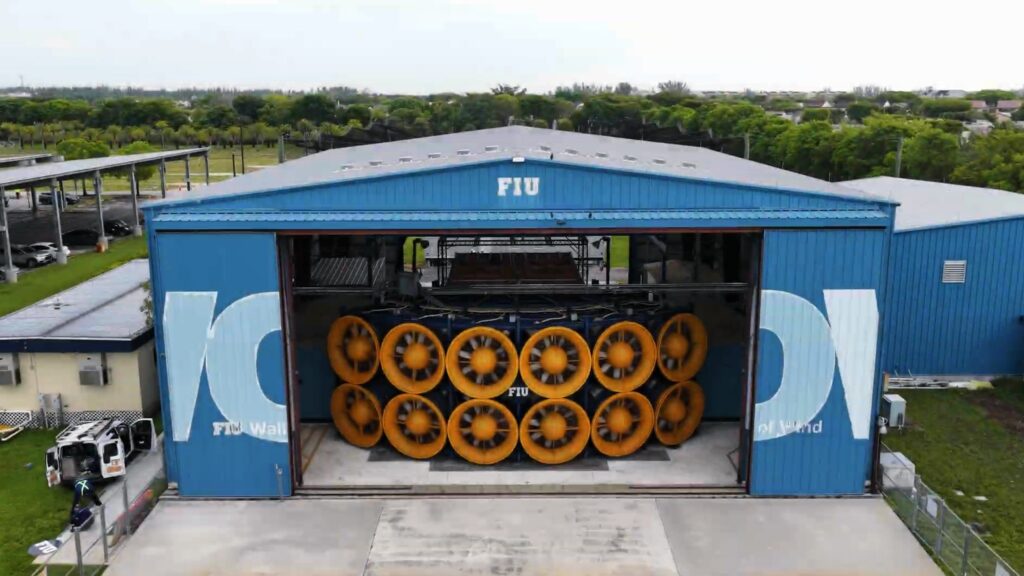
That’s the place FIU’s “Wall of Wind,” or WOW, is available in. Powered by way of 12 enthusiasts generating a mixed 8,400 horsepower, the ability is the one one within the nation able to producing winds sturdy sufficient to compare the ones of a significant storm.
Hurricanes are categorised partially by way of sustained wind pace. A Class 1 storm starts at 74 mph, whilst a Class 3 storm—thought to be a significant hurricane—brings winds of 111 to 129 mph. Class 5 storms achieve 157 mph or upper. WOW maxes out round that 157 threshold.
What the early exams confirmed
A part of what researchers are hoping to grasp from this spherical of experiments is how native rules might want extra rigorous requirements for those properties. To unpack the ones variations, they examined their prefab unit throughout various hurricane settings and native rules.
First, researchers examined Florida’s same old, blasting a unit with 130 mph winds after which 150 mph winds. Via the second one check, most of the single-stack, gravity-supporting masonry piers had blown out, along side a number of home windows, consistent with the Miami Bring in, which was once provide for the check.
Then, researchers examined how the similar house may carry out beneath stipulations extra commonplace in Kansas. To copy native necessities, they got rid of kind of 40% of the house’s anchors and ran the enthusiasts at 110 mph, then 130 mph.
This time, the house broke loose from its anchors solely, finishing two complete somersaults.
Whilst researchers will want months to investigate the information ahead of they are able to make particular suggestions, the adaptation in efficiency between the Kansas and Florida requirements already proved the bigger level: The similar house may have massively other results relying at the necessities it’s constructed and anchored to fulfill.
What comes subsequent
Researchers don’t seem to be preventing at wind, and so they hope so as to add extra excessive climate stipulations to long term exams.
“If this house was once examined beneath flooding and wind and hurricane surge, it could have failed previous,” Chowdhury mentioned. “We will check those beneath a lot more life like stipulations to create answers for resilience.”
That subsequent segment is also the place the analysis turns into much more consequential. Excessive storms hardly occur in isolation—they convey wind, water, saturated floor, flying particles, and moving foundations to endure on a house suddenly.
If researchers can pressure-test how the ones forces mix to push a manufactured house previous its limits, they can be offering clearer steerage on the right way to make this kind of housing more secure within the storms householders are more and more more likely to face.
The ones suggestions may just form no longer simplest how manufactured properties are constructed and anchored, however how safely they are able to serve the thousands and thousands of American citizens who already depend on them—and the numerous extra who might flip to them as conventional homeownership strikes additional out of achieve.