New York Gov. Kathy Hochul introduced a handshake price range deal this week that features a arguable pied-à-terre tax on moment houses in New York Town.
The transfer displays an an increasing number of widespread tactic for lawmakers dealing with affordability crises which might be squeezing constituents whilst blowing holes in state budgets. Quite than taxing the wealthy immediately thru upper source of revenue or company taxes, they’re taking intention at considered one of their maximum visual symbols of wealth—the second one domestic.
However how and the place those taxes are levied is every other tale fully. There are no less than 4 mechanisms for second-home taxes, and energetic or proposed variations exist in no less than 8 states.
As those taxes unfold, the larger query could also be whether they if truth be told paintings.
“Economically, those taxes do not in reality make any sense,” Abir Mandal, senior coverage analyst on the Tax Basis, tells Realtor.com®.
Whilst second-home house owners could also be a very easy goal, those taxes ceaselessly fail to provide the income promised or ship actual affordability for citizens, Mandal provides.
The place second-home taxes exist—and the place they’re headed
Cameron LaPoint, assistant professor of finance on the Yale Faculty of Control, says there was once a surge in second-home taxes around the globe within the early 2010s. As monetary markets was extra built-in following the 2008 monetary disaster, many countries grew involved that an inflow of out of doors capital would displace citizens.
If that sounds acquainted, it’s for just right explanation why. Many U.S. states are dealing with equivalent pressures these days, as power housing shortages—now estimated at 4.03 million gadgets national—pressure up costs and squeeze out native patrons.
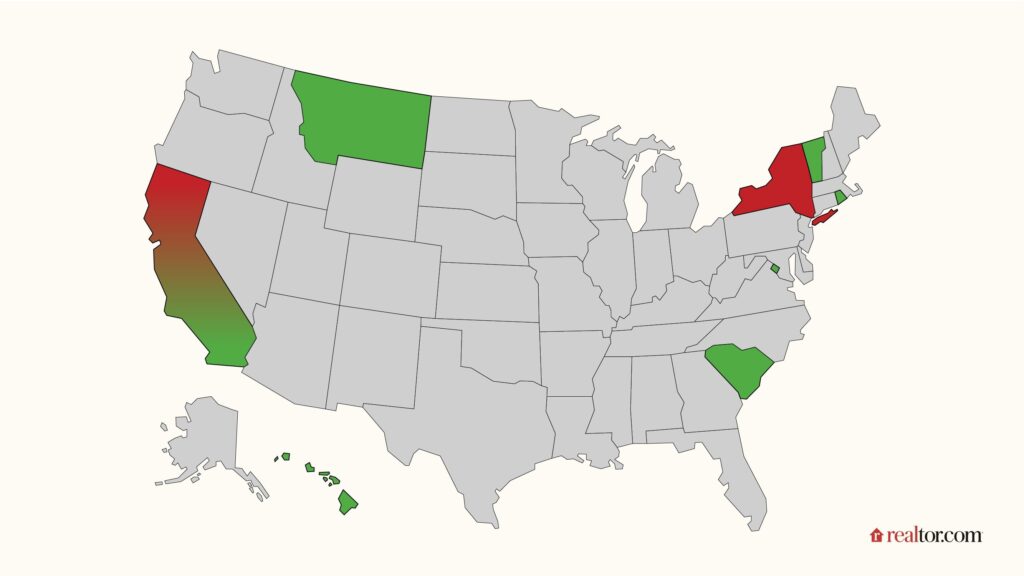
Unsurprisingly, the states lately imposing second-home taxes are amongst the ones maximum pinched through the lack: California, Hawaii, Montana, New York, Rhode Island, South Carolina, Vermont, and the District of Columbia.
Of the ones states, simplest South Carolina, Vermont, and Washington, DC, scored passing grades on their affordability document card from Realtor.com—incomes an A and two C-’s, respectively. The rest states all scored within the backside 10 national, with grades of D or decrease.
Whilst a shared affordability disaster hyperlinks those areas, the levying authority stays a long way from uniform. Most effective 4 jurisdictions—Rhode Island, Montana, Vermont, and South Carolina—follow such taxes on the state stage. The remaining choose home-rule approaches the place native municipalities take the lead.
In Hawaii, as an example, each and every county levies a better assets tax fee on moment houses, however the charges range through island. Honolulu, for example, triggers a better tier for houses valued over $1 million, whilst Hawaii County does so at $2 million.
The record is simplest poised to develop because the affordability squeeze deepens.
In June 2026, San Diego citizens will make a decision on Measure A, which proposes a flat tax beginning at $8,000 for vacant moment houses. San Francisco is weighing a equivalent reinstatement of its emptiness tax following fresh court docket demanding situations.
How second-home taxes are levied
A part of the trouble in monitoring second-home taxes is the sheer number of tactics they’re levied—a variety that mirrors the native prerequisites that impressed them.
In tourism sizzling spots like Montana, Hawaii, and South Carolina, a better assets tax burden appears to be the most well liked approach. This technique purposes precisely because it sounds: Nonprimary citizens are positioned in a unique tax bracket and pay a better base fee than native householders.
In the meantime, New York Town and Rhode Island are prioritizing assets tax surcharges, which act as an extra layer of tax hitting the entire cost of the house on most sensible of usual exams.
Whilst the fantastic print for the New York Town proposal continues to be being finalized, Rhode Island gives a glimpse of what it might appear to be.
Beneath the present legislation, non-owner-occupied houses valued over $1 million face an annual surcharge of $2.50 in keeping with $500 of assessed cost. It is been nicknamed the “Taylor Swift Tax” since the singer’s Watch Hill mansion may reportedly cause a annually surcharge of roughly $136,000.
It is price noting that a number of different jurisdictions—akin to New Jersey and Los Angeles—levy equivalent “mansion taxes” on high-value transfers. Then again, those are usually one-time charges brought on simplest on the level of sale and follow to all householders, even number one house owners.
Do second-home taxes paintings?
The looming query is whether or not those taxes if truth be told ship on their guarantees. Consistent with each Mandal and LaPoint, the proof is skinny in the case of each helping affordability and plugging income holes.
It is an extremely crucial attention for New York Town, the place the proposed pied-à-terre tax is meant to lend a hand shut the cheap deficit exceeding $5 billion.
Even the Comptroller’s Place of business has signaled warning, acknowledging that behavioral adjustments and marketplace fluctuations may scale back the promised $500 million in annual income to as low as $340 million.
A large a part of the issue, Mandal notes, is that those taxes goal the demographic with probably the most flexibility.
“Such taxes by no means supply the type of income that they first of all assume, as a result of there is a massive behavioral reaction to such taxes,” he explains.
2d-home house owners generally possess really extensive monetary sources. This affluence permits them to relocate to spaces with extra favorable tax insurance policies. They’re additionally adept at navigating the levy’s explicit triggers.
The mix makes the tax base very slippery, and that is the reason already a documented downside in New York state. Between 2019 and 2023, an estimated $9.9 billion in annual adjusted gross source of revenue fled the state for puts with extra favorable tax insurance policies, akin to Florida.
Now, a equivalent reaction to the second-home tax already appears to be mounting. Billionaire Ken Griffin has threatened to depart the state and pull an enormous funding in a brand new place of job construction. As town stares down its deficit, the transfer serves as a sobering preview of the way the tax may backfire.