From cussed inflation, disagreements on Capitol Hill over the Federal Reserve’s financial insurance policies, geopolitical tensions within the Center East, energy-driven inflation, and the approaching midterm elections, there is not any scarcity of uncertainties damn the inventory marketplace this yr.
While you have a look at any this kind of problems in isolation, you may suppose the inventory marketplace is headed towards freefall. However even with the entire drama, the S&P 500 (^GSPC +1.20%) is up just about 3% in 2026. That is vital to name out, as maximum buyers shortchange the index’s resilience.
With that stated, a little-known marketplace indicator might be sending an ominous caution that buyers are in large part overlooking presently. Let’s unpack what buyers will have to be expecting for the rest of this yr, as volatility apparently is not going away anytime quickly.
Symbol supply: Getty Photographs.
The S&P 500 CAPE ratio reached its second-highest degree in historical past
When taking note of monetary information techniques, it is not peculiar to listen to commentators assess valuation within the total marketplace somewhat than a selected inventory. In most cases, when an analyst is discussing whether or not the marketplace is over- or undervalued, they’re relating to revenue. In different phrases, Wall Side road benchmarks the typical price-to-earnings (P/E) or ahead revenue multiples around the index in opposition to historic thresholds to resolve whether or not the marketplace is frothy.
Do not get me unsuitable: Examining those metrics will also be rather useful. However in my eyes, conventional valuation multiples fall quick at taking pictures extra nuanced valuation dynamics. As a substitute, I make a selection to have a look at the cyclically adjusted price-to-earnings (CAPE) ratio.
The CAPE ratio is lovely nifty as it accounts for revenue over the last 10 years. Via casting its web this huge, the CAPE ratio inherently captures and smooths out other financial cycles, inflation ranges, and one-time occasions that affect revenue high quality available in the market.
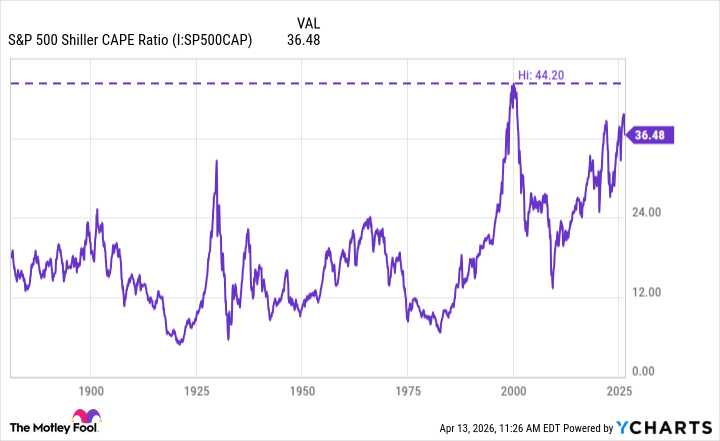
S&P 500 Shiller CAPE Ratio information via YCharts
Because the graphic illustrates, the CAPE ratio these days sits at 36. That is the second-highest studying in historical past and about 18% underneath its checklist degree of 44.
Why is a emerging CAPE ratio vital, and what does it sign concerning the path of the inventory marketplace?
There are two notable peaks within the CAPE historic chart. The primary took place all over the overdue Twenties, when the CAPE ratio reached a then-record degree within the mid-30s. The second one top — which is the best-ever prime — took place just about 25 years in the past.
In each instances, the inventory advertised cratered following a pronounced surge within the CAPE ratio. Again within the Twenties, the marketplace crashed, and the financial system entered the Nice Melancholy. In more moderen historical past, the dot-com bubble burst within the yr 2000.
For the previous couple of years, the S&P 500 has been in a bull marketplace, pushed via the synthetic intelligence (AI) revolution. But even so generation shares, peripheral industries that contact AI — comparable to calories and industrials — have helped pressure the inventory marketplace to checklist highs. Whilst the generational bull run has taken a breather in 2026, the CAPE ratio suggests the S&P 500 would possibly nonetheless be overestimated relative to historic norms.
Given those dynamics, historical past means that the inventory marketplace might be headed for a harsh, long-lasting crash simply because it did after the CAPE peaked again within the Twenties and 2000.
Will the inventory marketplace in truth crash in 2026?
Along with those historic patterns, the Nasdaq Composite technically entered correction territory in overdue March. In many ways, this weak spot helps the speculation that the inventory marketplace is fragile and is destined to plummet additional.
Whilst it is simple to apply this common sense, I see issues a bit of another way. All over the overdue Nineteen Nineties, most of the casualties of the dot-com generation had no trade fetching top class valuations within the first position. In different phrases, many corporations that went bankrupt via 2000 by no means had a concrete, detailed plan to get pleasure from the upward thrust of the cyber web.
Quite, those corporations merely relied at the transformative narrative of internet-driven applied sciences to marketplace how their trade would develop into. However those pipe desires seldom got here to fruition.
Whilst it is simple to glue dots between the dot-com growth and the synthetic intelligence (AI) supercycle, I in the long run see those revolutions as other alternatives. Many corporations, particularly in large tech, are already monetizing AI services and products profitably — permitting them to reinvest within the generation and develop their ecosystems.
However, I’m going to admit it is tough to expect the inventory marketplace’s near-term trajectory. As referenced previous, there is not any scarcity of variables fueling uncertainty around the inventory marketplace this yr.
The prudent technique is to cut back publicity to unstable enlargement shares or speculative positions. For now, complementing a wholesome money steadiness with blue chip shares that boast different earnings streams and sturdy trade fashions is a good way to insulate your portfolio from oversized volatility. Even supposing the marketplace does crash, this structure will have to restrict your losses whilst additionally giving you good enough monetary flexibility to shop for the dip.