The wealth hole in The usa is taking a brand new form — and it’s now not only a divide between the well-off and the financially prone.
In February, the Financial institution of The usa Institute signaled that the commercial image was once starting to turn out to be: “Source of revenue‑primarily based divergence in spending and salary expansion persists, and we’re involved {that a} “Ok” form is opening up between higher-income families and middle-income families, along the prevailing hole with lower-income families.”
In different phrases, as middle-income American citizens alternate spending behavior, they’re splintering from the highest of the “Ok” and forming a 3rd tier. The result’s what some analysts describe as an “E-shaped” economic system. It will sound like alphabet soup, however the form displays a extra fragmented monetary truth for U.S. families.
Contemporary information underscores the stress persons are already feeling: Shopper sentiment has fallen to a four-year low throughout revenue, age, schooling and political teams, consistent with the College of Michigan’s Index of Shopper Sentiment launched on Might 1.
Meet MoneyNerd, your weekly information decoder
Such a lot information. So little time. NerdWallet’s new weekly e-newsletter is sensible of the headlines that have an effect on your pockets.
SUBSCRIBE FOR FREE

What defines the ‘E-shaped’ economic system?
Many economists nonetheless describe the economic system as “Ok-shaped,” however fresh information means that’s converting.
If the “Ok-shaped” economic system was once about who was once pulling forward and who was once falling in the back of, the rising “E-shaped” economic system displays an extra spoil— with a rising center tier uncovered to monetary rigidity with out as large of a buffer to control it as most sensible earners have
Slowing salary expansion
Salary expansion for middle-income American citizens has cooled. Heart-income employees noticed actual hourly wages upward thrust about $1.75 from 2020 to 2025 — kind of $0.66 not up to pre-pandemic developments would have predicted, consistent with February information from the Federal Reserve Financial institution of Cleveland.
When in comparison to increased incomes families, middle-income employees are falling additional in the back of. Over the last yr, Financial institution of The usa Institute information displays higher-income families noticed salary expansion of about 5.6% year-over-year in March — the most powerful since August 2021 — whilst middle- and lower-income families noticed good points of simply 2% and 1%, respectively. The distance is the widest because the financial institution started monitoring it in 2015.
Added worth pressures
Chronic inflation has taken its toll on American citizens seeking to come up with the money for necessities. A December record from the Brookings Establishment discovered that about one-third of middle-class households combat to make ends meet.
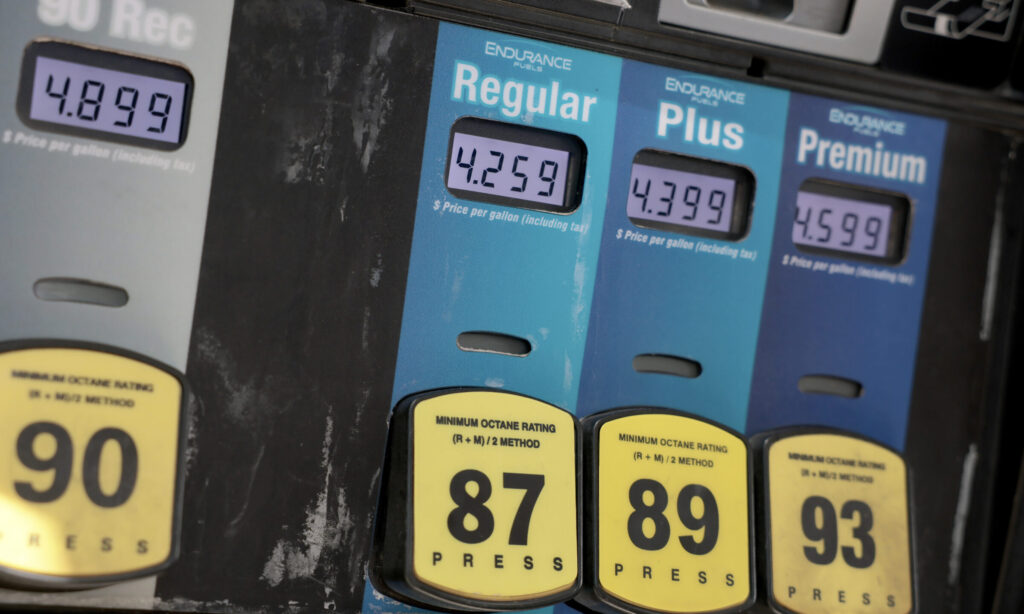
Contemporary information displays that pattern: The newest client worth index, a proxy for inflation, displays an 18.9% annual build up in gasoline costs in March; a 2.7% build up in meals costs; and a three% upward thrust in refuge prices.
Converting spending patterns
Spending patterns are diverging additional, with the higher-income families’ spending expansion some distance outpacing the ones in middle-income and lower-income teams, consistent with Financial institution of The usa Institute’s “Shopper Checkpoint” information for March.
The BoA research discovered that spending expansion for middle-income families has widened to its greatest hole in comparison to increased earners since mid-2022, with annual middle-income spending expansion up 1.7% as opposed to 2.9% for higher-income families and 1.1% for lower-income families.
The place are you within the E-shaped economic system?
There are 3 tiers within the “E-shaped” economic system, each and every representing one of the vital horizontal bars of the letter “E.” Income and spending behavior are the principle differentiators that decide the place you’re located within the E-shape.
Most sensible of the ‘E’: Upper revenue families — kind of 19% of the inhabitants — earn more than $169,800 once a year, consistent with Pew Analysis Middle. Contributors of this team have not modified their spending behavior a lot — and they are wearing the economic system because of this. The highest 10% of all earners account for kind of part of all client spending within the U.S. all the way through the second one quarter of 2025, consistent with a September research by way of Moody’s Analytics.
Heart of the ‘E’: Heart revenue families — kind of 52% of the inhabitants — earn between $56,600 to $169,800 once a year, consistent with Pew Analysis Middle. This team has shifted from the highest of the “Ok” right into a extra financially-constrained place. This team is feeling extra insecure and, because of this, is curtailing how they spend their cash. They’re in all probability to have a bank card and raise per 30 days balances from month to month, consistent with Federal Reserve information from final yr.
Backside of the ‘E’: Decrease revenue families — kind of 28% of the inhabitants — earn not up to $56,600 once a year, consistent with Pew Analysis Middle. This team is extra reliant on credit score, together with payday loans and “purchase now, pay later” merchandise, Federal Reserve information from final yr displays. Decrease-income adults are much less prone to have bank cards or financial institution accounts, however amongst those that do have bank cards, they generally tend to hold balances from month to month.