Image it: Gasoline is $2.69 according to gallon, eggs are $1.50 a dozen, and hire is solely $1,300 per 30 days.
It’s 2019 in The us, and the rustic has but to move over the years of top inflation that may pressure the cost of fuel as much as $4.10, eggs to $6.22, and hire to $1,700—in conjunction with the price of many different necessities.
Whilst it’s no secret that affordability has plummeted for the reason that pandemic, a brand new research from the Not unusual Sense Institute (CSI) finds that some states had been hit tougher than others.
Lately, the common U.S. family has about $2,170 in per thirty days discretionary source of revenue after overlaying taxes and necessities like meals, fuel, and refuge. However for the ones in the slightest degree reasonably priced states, the excess shrinks to only $800.
Housing stays without equal budget-breaker, and the best driving force of state-by-state variations in affordability. The common family faithful 18.5% of its source of revenue to refuge and utilities in 2025. However that baseline shifts dramatically relying at the map: shedding to 13.5% in essentially the most reasonably priced state and spiking to a staggering 28.8% in the slightest degree reasonably priced one.
It’s a dramatic show of ways the housing disaster has spilled over into a bigger affordability disaster. General, the document unearths that families want to spend $15,400 extra according to 12 months—or $1,280 per 30 days—simply to take care of the similar way of life they loved in 2019.
The moving panorama of affordability
CSI measured affordability from throughout six domain names—refuge and utilities, groceries, medical insurance, automotive insurance coverage, gas, and kid care—from 2019 to 2025.

The information finds a constant upward march throughout all classes. All over the length tested, fuel rose 16.5%, medical insurance larger 22.8%, grocery prices climbed 25.1%, whilst the blended expense of refuge and utilities surged 33.9%.
Kid care rose a whopping 39%, however essentially the most competitive proportion build up took place in automotive insurance coverage, which ballooned 41.2% over the similar length.
But, proportion issues do not inform the entire tale.
Whilst different prices technically climbed sooner, refuge stays the heavy anchor of the American funds. And as it instructions the biggest portion of family spending, households are uniquely prone to even reasonable swings in housing prices.
“Refuge is the biggest family expense captured on this research and is the overpowering driving force of the affordability disaster in step with our scores,” writes Zachary Milne, senior economist and analysis analyst at CSI and the document’s writer. “Refuge prices have formed the affordability panorama significantly over the past a number of years as the main fiscal constraint going through U.S. families.”
On reasonable, annual refuge and utilities bills by myself larger $4,934 from 2019 to 2025—a large mounted and crucial value that ripples via each different monetary choice.

The place affordability took the largest hits
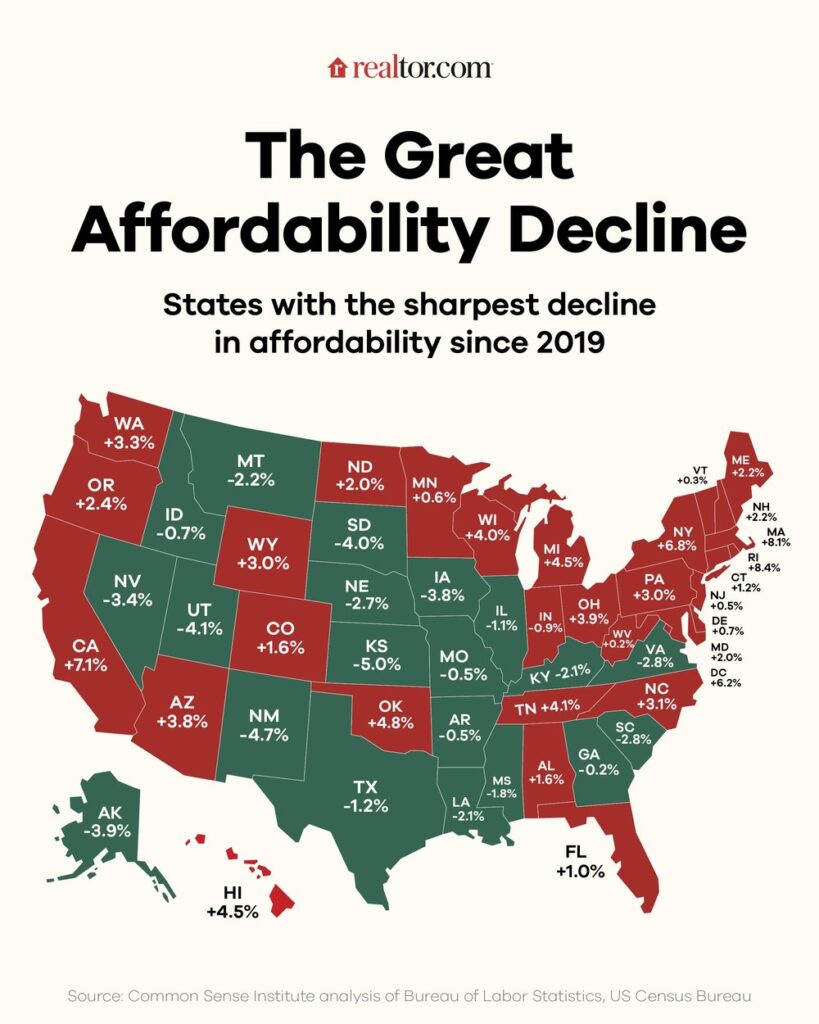
The decline in affordability was once fashionable, with 29 states and the District of Columbia seeing a internet loss in family buying energy. On reasonable, citizens in those states successfully misplaced 3.2% in their source of revenue to the emerging tide of costs.
Alternatively, the deterioration was once maximum critical in a handful of coastal and Northeast hubs. Rhode Island noticed the sharpest decline, the place families are spending a staggering 8.4% extra in their source of revenue on upper prices. Massachusetts adopted intently at 8.1%, with California score 3rd at 7.1%.
Those names can be acquainted to somebody monitoring the housing disaster. All 3 earned “F” grades at the State-by-State Affordability Document Playing cards from Realtor.com®—pushed by means of top housing costs and slow new development.
“For the states nonetheless suffering with affordability, it isn’t a case of which is the offender between provide, call for, or ancillary prices; it is in most cases all 3,” says Jake Krimmel, senior economist at Realtor.com.
Rhode Island—which ranked ultimate within the general document card—accounts for 0.3% of the U.S. inhabitants, however filed simplest 0.1% of allows in 2024, regardless of new development properties difficult a 43.8% top class. However, Krimmel notes, housing is never a solitary burden.
“One thing more that stood out was once how correlated housing prices and kid care have a tendency to be,” he says. “States that ranked low on housing affordability continuously additionally did on kid care affordability, representing a double whammy for households.”
Once more, the geographic cut up this is hanging.
In Kansas—the country’s maximum reasonably priced state for the provider—a regular family spends 11.1% of its source of revenue, or kind of $915 per 30 days. In the meantime, in New York, that per thirty days burden just about triples to a staggering $2,446, in step with the document.
The place affordability if truth be told stepped forward
In spite of the nationwide pattern, 21 states controlled to greenback the disaster and spot modest enhancements in affordability. Importantly, costs didn’t if truth be told drop in those areas; somewhat, native source of revenue enlargement outpaced the emerging value of dwelling, leaving families with extra respiring room on the finish of the month.
Kansas led this crew, with families spending 5% much less in their general source of revenue on necessities when put next with 2019. New Mexico adopted intently at 4.7%, with Utah seeing a 4.1% development.
In line with Krimmel, those luck tales in most cases stem from two other assets: “In terms of what states have performed proper, there may be all the time a component of success and a component of ability.”
For Kansas and New Mexico, the merit was once in large part success in dodging the large pandemic-era affordability rush that noticed prices skyrocket in areas just like the Solar Belt. As a result of call for stayed stable, their baseline prices did not explode.
Utah, on the other hand, is the top instance of ability. In spite of being an epicenter for pandemic migration, the state controlled to stay its head above water via competitive coverage.
“Utah noticed its native financial system increase, which ended in each emerging area costs and earning,” Krimmel explains. “However as a part of that increase, Utah was once additionally in a position so as to add to development to offset much more area worth will increase.”
For a way of the size of this effort, Utah was once answerable for 1.6% of the country’s new construction allows in 2024, regardless of having simply 1% of the U.S. inhabitants. And by means of construction its manner during the increase, the Beehive state proved that provide is without equal protect towards an affordability disaster.
A rustic divided by means of the base line
As politicians at each echelon of presidency scramble to take on the emerging value of dwelling, the teachings from the CSI research are transparent: If you wish to repair The us’s affordability woes, you will have to get started with the housing disaster.
Refuge is the gravity that defines a family’s monetary orbit, and when it is out of stability, the remainder of the cheap follows.
However right here once more are some punishing numbers. The U.S. is recently going through a housing scarcity estimated at 4.03 million to ten million properties—a deficit so massive it could as neatly be a black hollow. In the meantime, builder self assurance is tanking as top rates of interest and fears of an financial downswing take grasp.
To construct our manner out would possibly come all the way down to the standards Krimmel discussed previous: a number of ability to navigate the uncertainty forward, and a hefty dose of success.