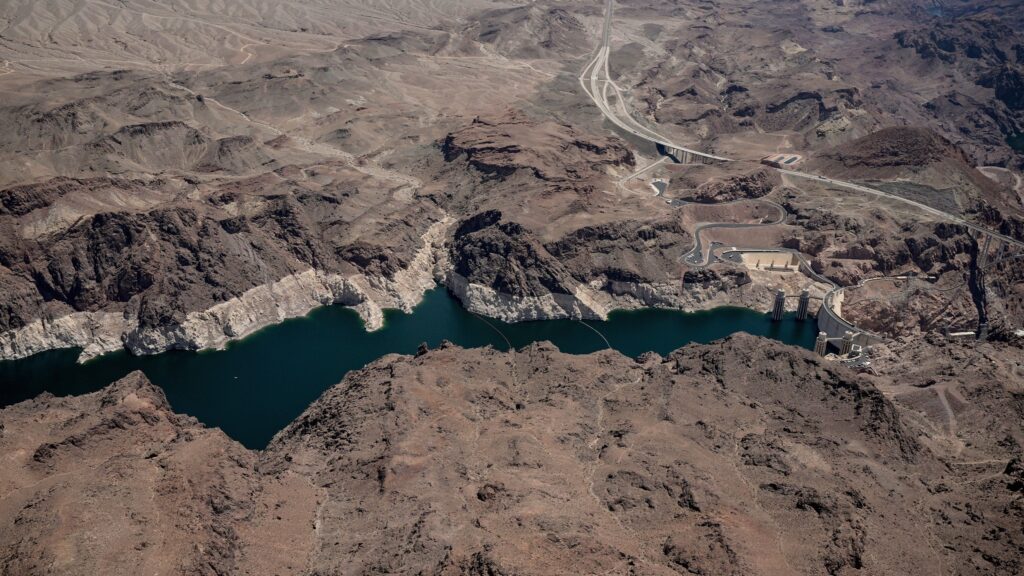
Arizona, California, and Nevada have proposed a high-stakes plan to preserve 3.2 million acre-feet of Colorado River water thru 2026. Whilst the purpose is to stabilize the West’s maximum necessary waterway, the deal indicators an everlasting shift for the area’s actual property: The generation of water-unlimited expansion is formally over.
“We’ve been used to an international in which there is limitless provide, and now we are not in that global anymore,” says Laurie Schoeman, founder at Housing for a Converting Local weather and a former senior housing adviser to the White Area underneath the Biden management.
Her caution comes at a time when few are connecting the dots between the continuing Colorado River negotiations and the consequences they cling for the housing marketplace, which professionals like Schoeman say might be really extensive.
“While you counsel that you’ll broaden housing with out an confident water provide, you’re in reality severely impacting the power for that housing to be sustainable,” she says. “Development houses within the barren region with out an confident water provide isn’t a accountable use of municipal, state, or financial institution greenbacks.”
This month, native officers in Kearny, AZ—a small the town of underneath 2,000 other folks simply 85 miles from Phoenix—introduced town may just run out of water by means of July, after its allotment from the Gila River used to be minimize by means of 80%.
“It is a lifestyles and demise downside,” Curtis Stacy, Kearny’s mayor mentioned closing month—and it might be offering a grim preview of what’s to come back for the remainder of Arizona as its maximum necessary water provide hangs in limbo.
What’s within the new plan?
The brand new proposal is the results of just about 4 years of intense negotiations a number of the seven basin states and Mexico. A lot of the competition has targeted at the Decrease Basin’s water intake—an issue made extra sophisticated by means of its meteoric inhabitants expansion.
When the river’s rights have been settled in 1963, Arizona’s inhabitants used to be simply 1.6 million; lately, it exceeds 7.5 million.
That expansion presentations no signal of slowing, both. Arizona and California have issued extra residential development allows since 2020 than another Colorado River Basin states, in line with information from Realtor.com®.
That’s a part of the explanation why Decrease Basin states first of all resisted deeper discounts, regardless that their newest proposal marks a pivot towards extra competitive conservation. Below the plan, California would slash its Colorado River utilization by means of more or less 13% in 2027 and 2028, with Arizona and Nevada committing to even steeper cutbacks.
“With this proposal, the Decrease Basin is placing forth actual motion to stabilize water provide alongside the Colorado River,” JB Hamby, chairman of the Colorado River Board of California, mentioned in a commentary. “We’re placing ahead further measurable water contributions for the device. With out that, the device will proceed to say no.”
To position the dimensions of the plan into viewpoint, the promised financial savings—more or less 1.6 million acre-feet yearly—is set part of what all of the Higher Department (Colorado, New Mexico, Utah, and Wyoming) utilized in 2021.
Already, many are pointing to agriculture to make one of the vital greatest cuts, because the business makes use of up to three-quarters of the river’s water provide. However Schoeman says extra complete adjustments are wanted.
“I believe that each one too incessantly we simply hotel to having a look on the greatest water shopper, which in lots of portions of the rustic [is agriculture], and simply say, ‘Smartly, they have got were given to chop and minimize,’” she says. “I believe we want to have a clear-eyed take a look at what every sector is if truth be told the usage of.”
How water rights are already redrawing the map
And housing is indisputably a type of sectors. In Arizona, the struggle over the state’s 100-Yr Confident Water Provide (AWS) rule presentations why actual property is a part of the water minimize dialog—although nobody is pronouncing that section out loud but.
The law used to be designed to forestall reckless construction that leaves families stranded, and calls for builders to turn out a century of water availability ahead of development.
However an incapacity to take action has already resulted in a pullback in groundwater-dependent suburbs like Buckeye, Goodyear, and Queen Creek, in line with Arif Gasilov, a spouse at Gasilov Team, a sustainability and ESG consultancy.
“Since 2023, new subdivisions in Maricopa County that rely on unreplenished groundwater can not get AWS certificate, and builders within the west Phoenix metro are pivoting to infill or purchasing current water rights,” he explains. “That is including important prices consistent with lot as builders compete for restricted water rights.”
Schoeman additionally sees this as posing a long term problem for builders having a look to construct in those areas.
“One of the vital demanding situations is coping with the water scarcity implies that housing builders aren’t going with the intention to briefly pull allows and briefly get round this factor, as a result of there are not any actual choices being installed entrance of them,” she explains.
Whilst a pass judgement on struck down a state moratorium on new groundwater-reliant subdivisions in April 2026, the reprieve for builders and homebuyers will likely be short-lived if water shortage continues to get priced into the marketplace in alternative ways.
Everlasting answer or a momentary patch?
Whilst the brand new water-saving plan supplies a short lived reprieve for the river’s reservoirs, there has already been a basic shift within the monetary truth for citizens.
“For most of the people within the Phoenix house, for any home-owner, they will have to be expecting their water and wastewater expenses to move up sooner than the velocity of inflation for the foreseeable long term,” Brett Fleck, water sources adviser for town of Peoria, informed Realtor.com in January.
Gasilov says he’s seeing a equivalent shift in Nevada.
Whilst Henderson and North Las Vegas keep growing, the Southern Nevada Water Authority has needed to spend a vital quantity on infrastructure—like Lake Mead’s 3rd consumption—to stay water flowing.
“Infrastructure investments of that kind have a tendency to turn up in water charges, which then presentations up in housing prices,” Gasilov warns.
Past application charges, each Schoeman and Gasilov see a long term the place insurers and loan lenders get started pricing in water shortage to the marketplace.
“The way in which I see it, homebuyers in Phoenix do not test Lake Mead ranges ahead of making an be offering. However insurers, lenders, and appraisers are beginning to,” Gasilov says. “At the moment it is most commonly a construction constraint, however inside of 5 years it could possibly rather well change into a pricing sign.”
That is why Schoeman believes the strategy to the area’s housing wishes can’t be discovered by means of having a look again on the river.
“The answer isn’t to simply take much less water,” she says. “There should be a extra lively effort by means of each municipalities, by means of the state management, to paintings with builders to check out to determine a approach to meet that 100-Yr Confident Water Provide law, which can’t be modified.”
As the government evaluations this momentary plan to satisfy 2028 water targets, the way forward for the Colorado River stays a shifting goal. Within the interim, billboards around the Arizona barren region proceed to provide a easy caution: “Water is lifestyles, don’t waste it.”