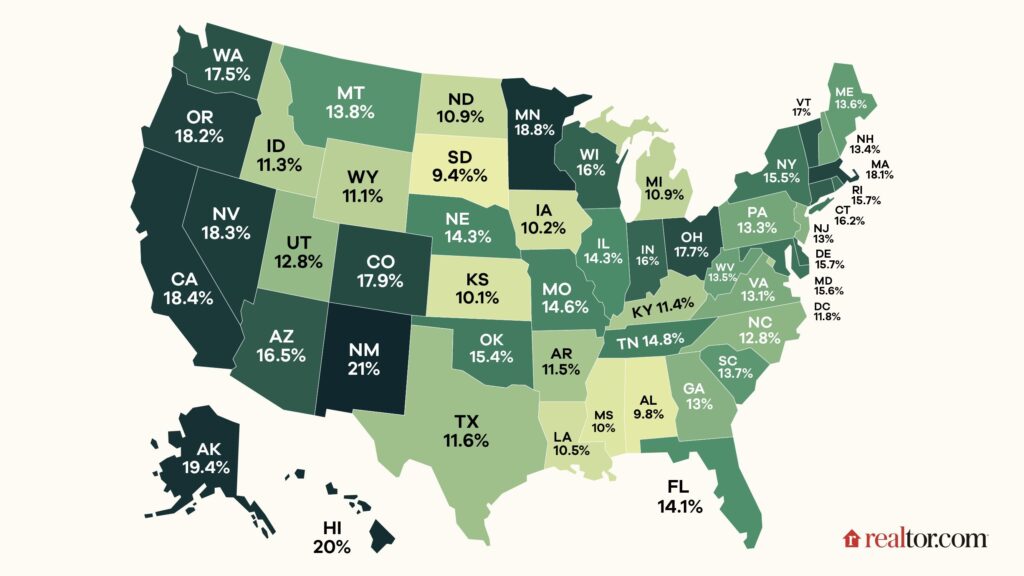
The U.S. Division of Well being and Human Products and services defines childcare as reasonably priced if it prices 7% or much less of a circle of relatives’s revenue. But, in each unmarried state, the standard circle of relatives a ways exceeds that threshold, qualifying them as “cost-burdened” by way of this very important carrier.
The timing couldn’t be worse as 1 in 3 house owners and 1 in 2 renters are these days regarded as cost-burdened by way of housing—placing the 2 greatest and maximum very important prices of a circle of relatives price range into direct pageant.
“Households with younger youngsters are going through this double whammy,” explains Yulia Panfil, director of the Long term of Land and Housing Program at New The usa, a assume tank. “If they do not pay for kid care, then they may be able to’t paintings, and if they may be able to’t paintings, then they may be able to’t pay hire. So it is this vicious cycle.”
And it is a dire overview of the truth households face nowadays. As a scarcity of four.03 million houses collides with a scarcity of four.2 million childcare slots, advocates argue those crises at the moment are inextricably intertwined.
The price of pricey childcare and housing
The clearest connection between housing and childcare prices is located within the demographic maximum vulnerable to shedding their houses.
Minors face the best menace of eviction within the U.S., consistent with analysis from the Eviction Lab. They account for more or less 40% of all folks threatened with displacement yearly. Moreover, families with youngsters constitute over part (52%) of all eviction filings.
“Just about 3 million youngsters are at the receiving finish of an eviction understand each and every 12 months, which is simply stunning,” says Panfil. “For such a lot of households, their two greatest family price range pieces are hire and childcare. And in towns like DC, the place I are living, the price of childcare in truth is upper than the price of hire for lots of, and that’s the reason in keeping with kid.”
That information is a stark representation of the unimaginable trade-off essentially the most cost-burdened households face: Pay for childcare so you’ll be able to paintings, however then fall brief on hire; or pay the hire, however lose your skill to paintings as a result of you’ll be able to’t have enough money the childcare.
The place households are essentially the most cost-burdened by way of childcare
Information from the Financial Coverage Institute (EPI) displays {that a} median-income circle of relatives in each state exceeds the 7% childcare affordability threshold by way of 2 to six proportion issues. For minimum-wage staff, the weight is much more critical—starting from 29 to 108 proportion issues.
Elise Gould, a senior economist on the EPI, started noticing a troubling shift within the information a decade in the past.
“Impulsively, childcare turned into costlier than housing in numerous counties around the nation,” she says. “It in point of fact shocked us.”
Nowadays, her analysis displays that toddler care prices greater than in-state school tuition in 29 states and the District of Columbia.
Joel Berner, senior economist at Realtor.com®, says that those pressures are hitting the housing marketplace, too.
“We are seeing it within the battle of first-time homebuyers,” he says. “This crew is of the age that they’re delicate to each loan charges (maximum do not already personal a house) and childcare prices, and they are getting squeezed within the West and in coastal markets.”
When inspecting how a lot of an average circle of relatives’s revenue is ate up by way of the mix of an ordinary loan and toddler care—it is the ones areas within the Western and coastal markets that stand out. Hawaii, California, and Massachusetts are affected essentially the most.
“Saving for a down fee is the most efficient factor a first-time purchaser can do on this atmosphere, but if different prices like childcare are too excessive as neatly, there is now not a lot left after the expenses are paid,” he provides.
The maths is even brutal for many who’ve been in a position to wreck into the marketplace.
In Hawaii, which ranks because the 6th costliest state for toddler care, childcare on my own consumes 20% of an average circle of relatives’s revenue, then including an ordinary loan fee brings that general to 75% in their income.
In the meantime, California ranks fourth for toddler prices, then including the standard loan on best of childcare consumes greater than 71% of the standard circle of relatives’s revenue.
The similar is correct in Massachusetts, which ranks as the second one costliest position for childcare. However the math is so restrictive within the Bay State that best 8% of households within the state can have enough money toddler care with out being cost-burdened.
And whilst those figures constitute conventional households at the median revenue, the squeeze is way more acute for minimum-wage staff.
In New Hampshire and Wisconsin, childcare prices on my own would devour 115% and 112% of a employee’s general income, respectively.
In a merciless twist, Gould notes that childcare staff are frequently essentially the most acutely harassed by way of the disaster they lend a hand arrange.
“Childcare staff are those which are doing this precious paintings to maintain our kids, they usually themselves are paid such low wages, and they are undervalued for that paintings, that they may be able to’t have enough money childcare themselves,” she says.
On reasonable, childcare staff must spend between 30% and 74% in their revenue on childcare on my own—earlier than even making an allowance for the price of housing.
The similar pressures using up housing are using up childcare prices
The truth that childcare prices have risen in close to lockstep with house costs isn’t any twist of fate. For plenty of childcare suppliers, their greatest fastened charge is hire—and as industrial and home assets values have surged, the ones overhead prices are handed at once to households.
That shift has hit residential suppliers—frequently essentially the most reasonably priced and versatile choices for households—specifically exhausting.
“Working a childcare industry isn’t one thing that one does for an enormous benefit, and so the smallest alternate can in point of fact have ripple results,” explains Erica Meade, coverage director of the New Observe Lab at New The usa. “If their hire is upper or their insurance coverage is upper, it has to get handed directly to households, or they consume it.”
As extra of those suppliers have closed, that’s additionally created shortage, which in flip drives up prices.
Nowadays, greater than part of the U.S. inhabitants (51%) lives in a childcare desolate tract, outlined by way of the Heart for American Development as a census tract with greater than 50 youngsters underneath age 5 and both no childcare suppliers or so few choices that there are greater than thrice as many youngsters as approved childcare slots.
As though that wasn’t sufficient, childcare facilities are going through an insurance coverage disaster of their very own in any other replicate to the skyrocketing premiums which are hitting some housing markets exhausting.
Samantha Phillips, an early training insurance coverage agent and recommend, says that she’s watched premiums swell from round $10,000 in keeping with 12 months for the standard web page in 2023 to greater than $25,000 in keeping with 12 months nowadays. And in high-risk spaces or websites that experience had claims prior to now, insurance policies can charge up to $45,000 to $75,000 a 12 months in keeping with web page.
In each dialog for this newsletter, one theme was once transparent: Households are in a second of disaster for the reason that industries they depend on are in disaster. To provide aid to 1 would require providing aid to all.
As Phillips put it: “I think like I have spent the remaining 3 years actually screaming from the mountaintops that doomsday is coming and doomsday is right here, and doomsday is getting worse.”