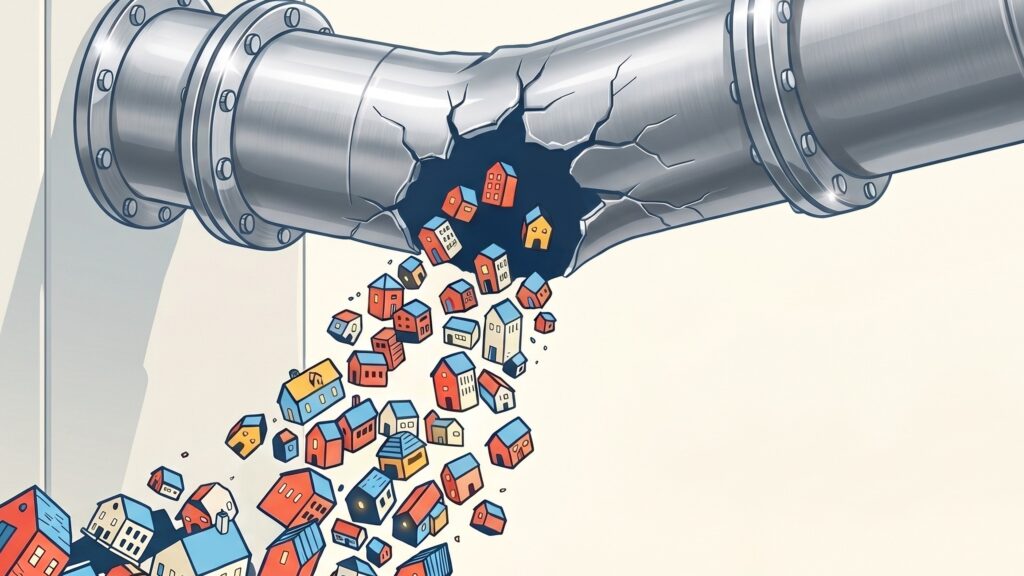
The usa’s housing scarcity is a key driving force of the affordability disaster, and homebuilders steadily blame exhausting native zoning and land-use insurance policies for proscribing their skill to construct.
However even with construction lets in in position, a myriad of alternative demanding situations steadily go away new residential building tasks lingering unfinished, a brand new learn about unearths.
The brand new research from the Federal Reserve Financial institution of St. Louis appears on the “leaky pipe” of incremental demanding situations that go away developers sitting on authorized housing lets in—given issues outdoor of the felony procedure.
This creates what the researchers name “inelastic housing delivery,” a state of affairs wherein new building does not building up in line with larger housing call for, as one would be expecting in a belongings functioning marketplace.
And it signifies that housing demanding situations are not simply regulatory. Even if developers have the entire felony necessities squared away, they might not be breaking floor. Realtor.com® senior economist Joel Berner says financial uncertainty is the perpetrator.
“Inflation has had the impact of compressing developers from each side,” Berner says. “Now not most effective do consumers really feel cash-strapped and no more susceptible to tackle a house acquire, decreasing call for for houses, however developers get their supply-side prices boosted as smartly.”
Lets in soared all over pandemic, however completions lagged
Through definition, a housing allow is issued a while sooner than the house is in truth whole. So having a look on the distinction between the 2 numbers provides a number one indicator of the place the marketplace goes, economist Manu Garcia and analysis director Carlos Garriga stated.
A prime choice of lets in are issued when developers really feel assured. The ones lets in in most cases turn into finished houses in numerous months to a 12 months. Lets in can best house completions by way of a large margin in excellent financial instances. For example, about 7.3 lets in have been issued in line with 1,000 folks in 2004, and six.5 devices have been finished.
However the lag in of entirety has narrowed within the post-pandemic building international. Developers bought ratings of lets in in 2021 and 2022 that have not but translated right into a corresponding bump in houses.
Then in 2024, the per-capita choice of finished houses hit 4.77 whilst the choice of lets in issued hit 4.33. It is the first 12 months since 2010 that per-capita lets in fell underneath per-capita completions.
“The COVID-19 pandemic length displays notable dynamics—lets in surged to five.2 in line with 1,000 in 2021 as call for spiked, however completions lagged as developers confronted remarkable delivery chain disruptions and hard work shortages,” the researchers stated.
Housing delivery hole nonetheless widening
Taken along with different information issues, the St. Louis Fed researchers confirmed how homebuilding patterns display a “cumulative hole” in homebuilding. Whilst the country would possibly no longer seem to be overbuilt by way of some measures, shifts in new family formation and emptiness display lingering results of underbuilding.
The Realtor.com financial analysis workforce estimates that the country has a housing delivery hole of greater than 4 million houses, in response to pent up call for from younger people who find themselves nonetheless residing with roommates or oldsters. That offer hole greater from the prior 12 months, appearing a troubling development of underbuilding.
In the meantime the White Area lately estimated the space at a staggering 10 million houses, in response to the extent of delivery that the country would have if homebuilders had saved up the development tempo observed previous to the 2008 International Monetary disaster.
Speculative homebuilding—this is, when a developer begins building on a brand new area with out a secured purchaser—has long gone by way of the wayside in recent times as building has slowed. Berner predicted that development would proceed so long as loan charges and gradual purchaser task proceed.
Developers were extra wary by way of sticking to fewer houses and plots on their stability sheets amid the previous few years’ tough local weather for housing, Berner says.
“Exertions and fabrics turn into costlier, which reduce into their benefit margins on the similar time that they are having to supply worth discounts and incentives for consumers,” Berner says. “It is simple to peer why the pipeline will get leaky when the possibilities for benefit are so glum.”
Get actual property information on your inbox