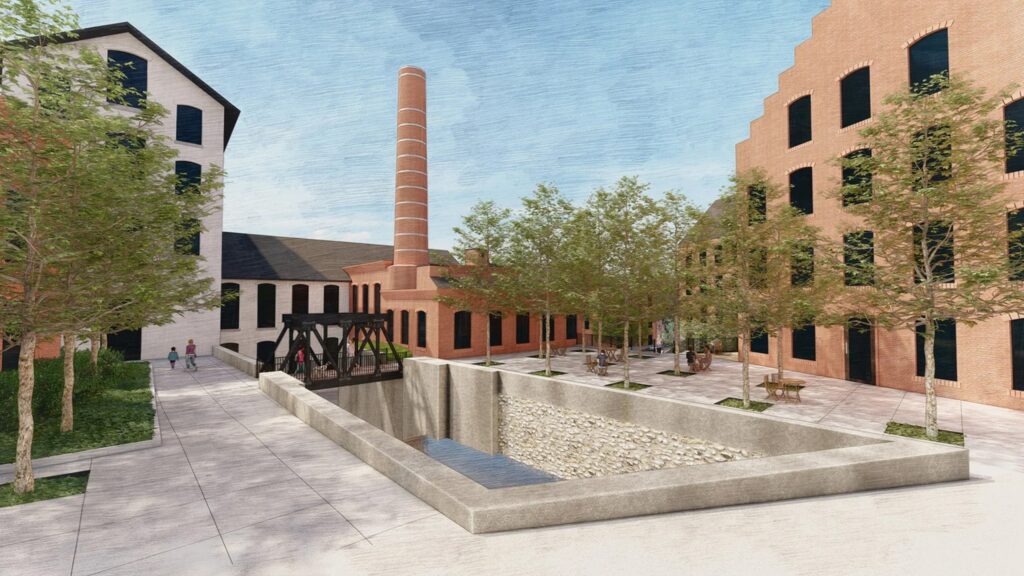
The ancient textile hub of Vernon, CT, is mired in a decade-long slog to transform an enormous complicated of vacant, crumbling turbines into 200-plus new residences—a hard and dear procedure that underscores the trouble of adaptive reuse as Connecticut faces the country’s worst housing scarcity.
The huge undertaking, now on its 3rd developer, revolves round a 130,000-square-foot complicated comprising a dozen hooked up structures that for many years housed the Amerbelle, Daniel’s, and Anocoil turbines close to the middle of the city, which is at the northeast outskirts of Hartford.
Shaun Gately, director of building products and services for the city of Vernon, tells Realtor.com® that the defunct turbines—the oldest of which date to 1868—are integral to the neighborhood’s identification, having produced wool for presidential fits, the primary parachute to land on Mars, and 30% of the arena’s sailcloth.
“It is a part of our skyline,” says Gately. “It would not be the similar in the event that they had been long gone. So the city, the state, our federal companions, and the developer are all hoping to maintain the structures and feature them stay a part of the neighborhood.”
The remaining manufacturing facility ceased operations someday between 2012 and 2015, and because then, the city has been in search of a viable trail ahead for the web page.
In step with Gately, Vernon confronted a quandary: Whether or not demolishing the blighted turbines or redeveloping them, pricey environmental remediation was once unavoidable because of a long time of commercial contamination.
Why new housing gained as opposed to the wrecking ball
Since a lot of the state investment for environmental cleanup was once contingent on holding the ancient buildings, stakeholders moved to transform the prevailing structures into housing reasonably than knocking them down.
On the other hand, Gately says there was once additionally an emotional measurement to the decision-making.
“In the event you move within and you notice the timbers, and you notice the brick, and you notice the water outdoor a window, you already know that they must keep,” he says of the previous mill buildings, which sit down the place the Hockanum River cuts throughout the center of the complicated.
“It is how the neighborhood was once shaped. This whole the city, our entire primary boulevard and downtown, was once constructed across the turbines since the turbines had been the employment middle.”
The plan is to turn out to be the warren of dilapidated commercial buildings into kind of 215 devices of personnel housing meant for other folks incomes 80% to 120% of the native median source of revenue, plus no less than 5,000 sq. ft of industrial house.
“Changing 130,000 sq. ft of blighted, tax-negative commercial house into greater than 200 residences is a real win, holding neighborhood persona whilst including significant density steps from a village middle,” says Realtor.com senior financial analysis analyst Hannah Jones.
Vernon Mayor Dan Champagne tells Realtor.com that the undertaking has 3 primary goals: beautifying the doorway to downtown, cleansing up a blighted web page, and injecting much-needed reasonably priced housing into the native marketplace.
The most recent developer that got here on board, Atlanta-based Camden Control Companions, which makes a speciality of mill redevelopment, will use state and federal tax credit to assist finance the undertaking.
The grueling fact of remediation
However ahead of building can start, the city will have to whole a large-scale, multimillion-dollar cleanup of the web page. Daniel’s mill, which produced fireplace retardant all over the Nineteen Sixties and Seventies, poses the best problem as a result of it’s permeated with extremely poisonous PCB chemical compounds, requiring the dismantling of each and every brick and beam.
It took municipal leaders years to cobble in combination roughly $7.5 million in federal and state grants—with the overall $2.5 million being awarded by way of Connecticut Gov. Ned Lamont in March—to release the laborious remediation procedure.
As soon as the cleanup is whole someday subsequent 12 months, the sprawling web page alongside East Major Boulevard shall be passed off to the developer, who is anticipated to spend 5 extra years turning the defunct turbines into leases.
“After I first met with him, some of the issues he mentioned was once that he does not foresee a benefit coming for moderately a couple of years ahead of or after he finishes the mill, however I suppose that is just about a long-term funding for him,” says Champagne.
Whilst Gately estimates a $60 million ticket to redevelop the complicated ahead of a unmarried resident can transfer in, the undertaking’s developer stays dedicated to the imaginative and prescient.
Town professional concedes that remodeling an previous commercial web page is far dearer than securing a vacant parcel of land and setting up a brand-new condominium tower, however there are different elements to imagine past steadiness sheets.
“If we will be able to supply reasonably priced devices and stay the tradition and structure and the whole lot there, then I feel it is a win.”
Connecticut’s determined hunt for housing provide
Mill redevelopment has been booming right through the Northeast and portions of the South for many years, as towns and cities throughout Massachusetts, Rhode Island, and the Carolinas race to turn out to be eyesores into reasonably priced housing hubs that anchor each ancient preservation and neighborhood revitalization.
In Connecticut, a survey performed by way of the group Preservation Connecticut known some 1,500 commercial websites as possible applicants for redevelopment.
It comes at a the most important time as “The Charter State” grapples with probably the most critical stock shortage crunch within the U.S. when evaluating March 2026 provide ranges to norms ahead of the COVID-19 pandemic.
A housing knowledge research from Realtor.com finds that during March, there have been 78% fewer houses on the market in Connecticut in comparison to 2017–19 ranges.
Closing fall, Connecticut was once one in every of simply seven states to earn an F at the Realtor.com State-by-State Housing Document Card, a part of the Let The united states Construct marketing campaign that tracks how successfully every state balances affordability and new building.
Emblematic of a lot of the Northeast, Connecticut’s housing provide is critically constrained by way of zoning restrictions, prime building prices, and restricted buildable land, placing upward drive on costs and leaving many citizens priced out.
In March, the median list worth in Connecticut stood at $507,500, which was once greater than $90,000 above the nationwide determine.
A contemporary “Truthful Percentage” housing find out about commissioned by way of the state Legislature confirmed that Connecticut will have to upload between 120,000 and 380,000 new housing devices to satisfy present call for—an enormous provide hole that mirrors the disaster roiling neighboring Massachusetts.
All this results in one conclusion: Connecticut will have to increase its reasonably priced housing via each and every to be had road, from new building to adaptive use of present houses. On the other hand, Jones issues out that the Vernon mill undertaking illustrates each the promise and the tempo drawback of this method.
“Mill redevelopments like Vernon’s are precious members to long-term housing aid, however Connecticut and its Northeast neighbors will wish to pair adaptive reuse with zoning reform that permits multifamily housing building close to transit and quicker allowing pipelines to actually transfer the needle on housing provide and affordability,” she says.
For Gately, then again, the undertaking transcends provide and insist metrics—it’s about ancient legacy.
“In the event you simply tore the whole lot down and constructed new, it might be great,” he says. “It simply would not be the similar.”
Get actual property information for your inbox