The battle in Iran is also on pause, however its results on costs are nonetheless in movement and can proceed to ripple throughout the financial system after greater than a month of disruption to the worldwide oil provide.
After the U.S. and Israel started their assaults on Feb. 28, Iran replied by way of last the Strait of Hormuz, a crucial chokepoint for the sector’s oil provide and different key fabrics. Brent crude — the worldwide oil benchmark — traded at round $80 according to barrel sooner than the assaults however spiked to smartly above $100 according to barrel because the battle wore on.
The White Area has been inconsistent in its messaging concerning the battle’s targets and the way lengthy it could final, and has been buying and selling rhetoric with Iran about the way to finish the war. Issues got here to a head this week as President Donald Trump set a Tuesday closing date for a ceasefire settlement — threatening to assault Iranian infrastructure and wipe out a complete “civilization” if no deal emerged.
Meet MoneyNerd, your weekly information decoder
Such a lot information. So little time. NerdWallet’s new weekly e-newsletter is sensible of the headlines that impact your pockets.
SUBSCRIBE FOR FREE

On Tuesday evening, not up to two hours sooner than Trump’s closing date, the 2 international locations brokered a two-week ceasefire to permit for persevered negotiations on a longer-term deal. Iran agreed to reopen the Strait of Hormuz all the way through the pause, despite the fact that the ceasefire is off to a tenuous get started: On Wednesday, Iran accused the U.S. of violating the phrases of the deal, as Israel persevered assaults on Lebanon.
Following Tuesday evening’s ceasefire announcement, oil costs fell temporarily and feature settled close to $95 according to barrel, and U.S. shares rallied.
Battle provides to already-rising inflation
The battle’s financial affect is compounded by way of the ripple impact of price lists already in position sooner than the battle started. On March 2, only a few days after the preliminary assaults, the Yale Price range Lab launched an up to date evaluation of tariff affects on shopper costs, discovering that prices of imported shopper items handed onto shoppers runs any place from kind of 40%-76% for “core items” — like electronics and attire — and 47%-106% for “sturdy items” — like motor automobiles and family home equipment.
Wells Fargo analysts cautioned in a March 23 document in opposition to over-extrapolating early information. “Early final April, the president’s proposed price lists appeared to some a ensure of an financial recession. That didn’t occur,” the notice learn. Analysts mentioned that the crude oil value surge would most likely produce international shopper value inflation, however famous that political and financial constraints will most likely shorten the battle’s length. “Whilst some possibility stays for intensive structural harm to Persian Gulf power infrastructure, we consider that all sides favor to not ruin what generates nearly all of the area’s source of revenue,” analysts mentioned within the notice.
In the meantime, the Organisation for Financial Co-operation and Construction (OECD) says that the battle in Iran will take a look at the resilience of the worldwide financial system. A March 26 document by way of OECD tasks that inflation within the U.S. will moderate 4.2% in 2026, reflecting upper power costs because of oil marketplace disruptions. A chronic war within the Heart East may just lead to a good steeper value surprise, it says.
Is the U.S. headed for a recession?
If the ceasefire fails to carry and hostilities proceed into June, oil has a 40% probability of hitting $200 according to barrel, consistent with Macquarie Crew, an funding banking company. A spike of that measurement may just push shopper costs even upper, roil markets and push an already fragile financial system over the threshold.
“My sense is that if we hit $150 to $200 a barrel for a month or two, that’s very prone to tip the financial system into recession,” says Daniil Manaenkov, a U.S. forecasting specialist and economist on the College of Michigan.
The Global Financial Fund (IMF) voiced identical issues in a March 30 weblog submit, cautioning {that a} extended war may just pressure up costs and sluggish financial enlargement international. The IMF analysts famous that the battle’s length, its unfold around the Heart East, and the ensuing harm to infrastructure and provide chains will form the dimensions of monetary fallout within the coming days, weeks and months.
What’s prone to get dearer?
It could actually take six to twelve months for growing power costs to filter out into the entirety else shoppers pay for, Manaenkov says.
Fuel costs is also top, however diesel is the actual motive force of upper general prices. Maximum freight delivery runs on diesel so when diesel costs upward thrust — and keep top — nearly the entirety else sooner or later follows.
“The timeline is usually you get power reaction temporarily, then it begins filtering into delivery prices, it begins filtering into shopper items after which it presentations up downstream in services and products,” he says. “The pass-through into services and products is clearly weaker than what you’ll see in power costs, however it will nonetheless be slightly significant.”
Right here’s what may just get dearer on account of the battle in Iran:
1. The rest that calls for diesel to move
Diesel powers vehicles and different freight automobiles, development apparatus, farm apparatus and marine vessels. When it will get dearer to energy the ones automobiles, prices are added to costs for a wide variety of manufacturing fabrics and completed items.
Diesel costs are up kind of 50% because the battle started, hitting $5.67 according to gallon on Wednesday, consistent with AAA, which tracks gasoline costs.
2. Air commute
Airways run on jet gasoline and prices have already sharply risen. In reaction, airways are already elevating price tag costs. Some plan to cancel flights to save lots of on gasoline prices; with fewer flight choices to choose between, there will likely be extra festival for seats on last flights, using up costs for commute even additional.
3. Meals
There are a couple of power issues concerned with meals manufacturing which can be getting hit by way of upper costs . Diesel to run farm apparatus and supply vehicles, which we’ve touched on already. However fertilizers are the most important factor, together with nitrogen fertilizers (calls for liquified herbal fuel) and phosphate fertilizers (comprised of urea, ammonia and sulfur), which can be key to generating meals staples like wheat, corn, rice, fruit and extra.
A few 3rd of all seaborne fertilizer passes throughout the Strait of Hormuz. If farmers can’t get reasonably priced fertilizer now, they gained’t have the ability to plant as a lot all the way through the spring planting season, which can sooner or later display up in upper costs.
4. Plastics and packaging
Plastic manufacturing calls for oil and herbal fuel. With about 85% of Heart Japanese polyethylene exports shifting throughout the Strait of Hormuz, uncooked fabrics that require plastic will cross up. That incorporates such things as water bottles, bank cards, furnishings, home items, meals bins, automotive portions and the rest this is sealed or wrapped in plastic.
5. Artificial clothes
Maximum clothes lately is comprised of petrochemicals, together with polyester, nylon, spandex and fleece. The garment business — particularly manufacturers of rapid type — depend on artificial fibers sourced via provide chains that run throughout the Strait of Hormuz. As shortages seem and prices of uncooked fabrics upward thrust, the material prices will upward thrust, too, and sooner or later display up in upper costs for clothes.
6. Generation and electronics
The tech and digital merchandise business is being suffering from twin disruptions. The Strait of Hormuz is a crucial delivery course for graphite feedstocks, which can be the most important for generating lithium-ion batteries — whilst helium is wanted for semiconductors, fiber optics, electronics and scientific gadgets. Provide disruption may just result in upper costs for smartphones, laptops, EVs, power garage methods and diagnostic scientific apparatus like MRI machines.
7. The rest made with aluminum
Gulf international locations provide about 9% of the sector’s aluminium. It additionally provides 21% of unwrought aluminum imports and 13% of wrought aluminum imports into the U.S.
Aluminum is very important for establishing constructions, automobiles, airplanes, electric energy transmission, home equipment and extra. Delays in aluminum exports may just hike up the cost of development merchandise, business apparatus, planes, vehicles and different equipment.
8. Vehicles
Plastic and aluminum value hikes, and different provide chain upsets, are prone to pressure up prices of automobiles, as smartly.
“Any disruption in manufacturing — say in South Korea or in Japan — has the prospective to snowball into manufacturing disruptions stateside, which would possibly give a contribution to normal scarcity of automobiles and pressure up new and used costs,” Manaenkov says.
Oil flows stay fragile, financial possibility mounts
Even after the battle ends, the float of delivery throughout the Strait of Hormuz would possibly not instantly go back to industry as same old, and fuel costs within the U.S. gained’t essentially fall. Iran can nonetheless keep watch over the float of oil, which might stay international and home gasoline prices increased.
In different phrases, even though the U.S. totally ends its involvement, Iran has leverage to stay financial power in position.
“It’s no longer like an on-and-off tap,” Manaenkov says. “If you forestall pumping, you wish to have to spend an important quantity of sources to restart the float.”
For now the war is on pause and visitors throughout the strait is slowly resuming, however the battle is a ways from over and unrest around the Heart East persists.
On Wednesday, simply hours after the transient truce was once made with the U.S., an Iranian drone hit a pumping station alongside Saudi Arabia’s crucial East-West oil pipeline — a key course for bypassing the Strait of Hormuz. It carries about 7 million barrels of crude according to day from the Gulf to the Purple Sea, and the wear may just additional compound the power disaster.
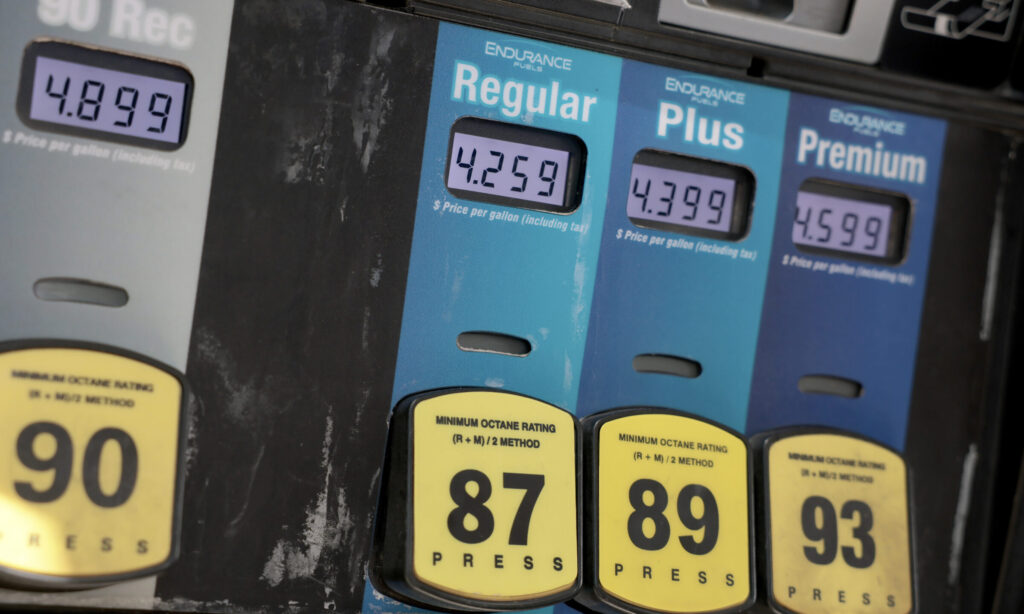
(Photograph by way of Joe Raedle/Getty Pictures)